How to protect yourself from identity theft? Discover the rules that will save you stress and money.
Our sensitive data is not just our first name, last name, or address, but also information about our health, political preferences, and even our facial biometrics. Data leaks online are everyday reality, and the fight for security is no longer about being invisible and avoiding social media. You have to react!
Discover four rules that are rarely talked about, but are worth knowing to increase your online safety and protect your digital identity.
An unpompted SMS is no accident
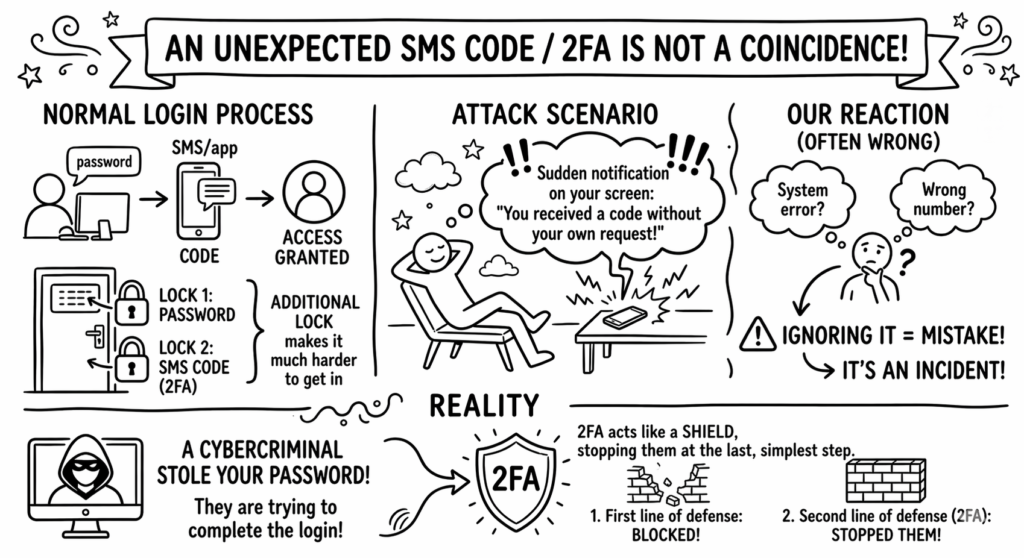
When logging into your bang or email, you enter a password, and then the system usually asks for a code from an SMS or an app (so-called 2FA, or two-factor authentication). It is an additional lock on your digital door, making it harder to get inside. But what happens when you are sitting on the couch, not touching your phone, and a notification with a login code pops up on your screen? We often think “it’s just a system error” or “someone simply got the wrong number”. Ignoring it is a mistake. This is an incident that should not be taken lightly.
Why it matters:
If you receive a code without initiating it yourself, you can basically be certain that a cybercriminal has already cracked your password and is trying to finalize the login. The two-factor authentication worked like a shield, stopping them on the final stretch, but the first line of defense (the password) has just fallen.
“If we get such a notification, and we are not the ones trying to log in, it means that someone has already acquired our password (…) we should log in as soon as possible and change our current password.” (Grzegorz Gąsiewski)
A blocked PESEL number does not complicate your life
Since June 2024, financial institutions in Poland are obliged to verify whether our national ID number (PESEL) is blocked before granting us a credit or loan. This option is available, among others, in the mObywatel app (just by moving a single slider). Many people avoid this solution, fearing that blocking their PESEL number will complicated their daily lives, freeze their bank account, or prevent them from seeing a doctor. This is a popular, but very harmful myth.
“Blocking your PESEL number does not limit us in any way. It is an additional security measure.” (Grzegorz Gąsiewski)
A scammer impersonating you at the bank will hit a wall, but you can still seamlessly use healthcare services, withdraw cash, make bank transfers, or buy train tickets.
Keep a poker face when dealing with a scammer
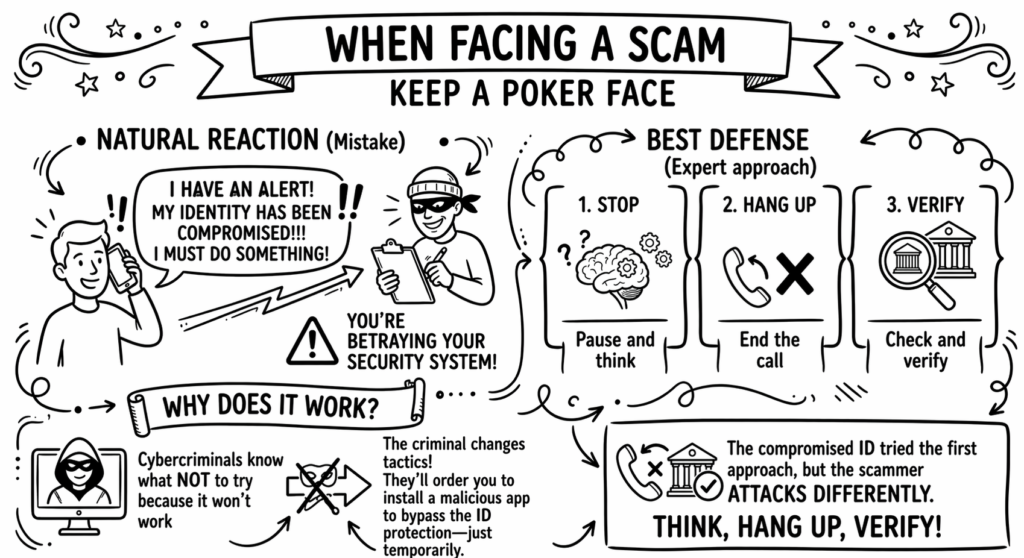
A scammer calls you claiming to be a bank employee. When you realize what is happening, your natural reflex is the desire to immediately expose their lie. We want to show that we are smarter: we tell them that we have BIK (Credit Information Bureau) alerts anyway, a blocked PESEL, and that nothing will come of it. Experts advise that exact opposite: keep a poker face, because this is the best way to protect our online identity.
Why it matters:
By revealing to the scammer what protection methods we use, we give them direct knowledge about our security system. Upon learning that our PESEL is blocked, the criminal can change tactics and try a different extortion method (e.g., persuade us to install malicious software to unblock the PESEL “for a moment”). The best defense against phishing and oher fraud attempts is taking a moment to think, hanging up the phone, and verifying the situation.
Early warning system
Most people find out the have fallen victim to identity theft at the worst possible moment – for example, by receiving a letter demanding the payment of a loan installment they never took out. Alerts and regularly checking your data on government portals or services like Have I Benn Pwned are the equivalent of brushing your teeth, but for your digital identity. It shifts the center of gravity from treatment (often court cases and debt collection dragging on for years) to prevention. We get a chance to block the fraud in real time.
“It is better to receive a notification about an attempt to verify your creditworthiness that to receive information about the repayment of the first installment of a loan you took out.” (Grzegorz Gąsiewski)
In conclusion
Protecting you online identity has long ceased to be the exclusive domain of IT system administrators. It is a very competency each of us needs. The tools at our disposal offer effective protection, provided we understand how they work.
Digital security does not mean giving up on technology. It is about using consciously, replacing rushing online with – as experts accurately point out – a “saving moment of reflection”.
You can listen to the entire conversation on Radio Zachód here.
Looking to enhance your cybersecurity?
Contact us!
Leave your details – we’ll call you back
Our specialist will get back to you no later than the next business day. You don’t have to fill in the message field, but a brief note about the topic you’re interested in will be a valuable hint for us.