ISO 27000 family standards – What do they regulate and why are they so important for information security?
Cybersecurity requires a proper approach. A highly effective solution for limiting the impact of threats on our systems and IT infrastructure – and consequently on the information collected by an organization – is the standardization of the approach to building safeguards.
This can be achieved through the effective implementation and application of information security management systems. To this end, it is worth looking into the ISO 27000 family of standards. They constitute a collection of standards regarding Information Security Management Systems (ISMS). They were developed by the International Organization for Standardization (ISO) and the International Electrotechnical Commission (IEC). Their aim is to ensure effective information security management within organizations and to protect information and data against threats, leakage, loss, or unauthorized access.
PN-EN ISO/IEC 27001 Information Security Management System
The most recognizable standard is PN-EN ISO/IEC 27001, which concerns the Information Security Management System (ISMS). Constantly evolving technology stimulates an increase in the number and variety of cyber threats; therefore, effective information security management is becoming an inseparable element of every organization’s strategy.
The aforemantioned standard is a guide that helps organizations consciously protect collected data, construct secure information processingal processes, and adapt to constantly changing external and internal risks.
An Information Security Management System implemented in accordance with ISO/IEC 27001 is a useful tool that allows for the creation of appropriate safeguards, taking into account the specifics of the organization’s operations, its business strategy, and its goals.
In connection with the upcoming entry into force of the new cybersecurity directive (NIS2), a wider group of organizations wille be interested in implementing the comprehensive approach resulting from this standard and some will require it from their contractors. The processes implemented by the Perceptus SOC are certified for compliance with these guidelines.
A key point of ISO/IEC 27001 is the necessity of conducting a risk assessment (often used synonymously with “risk estimation”). The system is designed in such a way that specific security measures are established through the risk assessment process.
The Deming Cycle in ISMS
The entire standard is based on the so-called Deming Cycle (PDCA), which consists of four looped phases, as seen below.
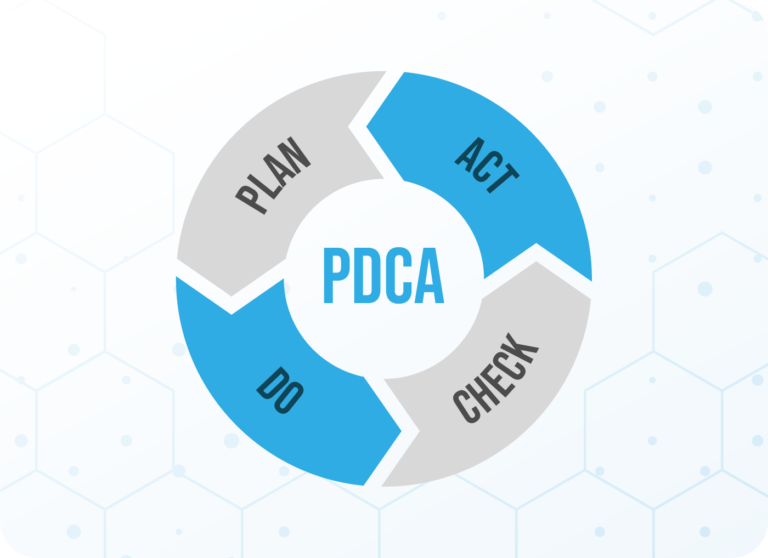
All actions taken by the organization should be Planned. Goals and the planned way of achieving them require definition. Next, we Do (execute) the activities needed for success according to the plan. In the Check phase, we verify whether the “Do” phase reflects the provisions of the “Plan” phase. The Act phase serves to correct imperfections.
Processes planned on a foundation of risk analysis
Planning itself in the field of information security management is strictly based on risk management. The whole idea of risk is the key – the foundation upon which all processes are built.
If a specific goal exists, there is also a risk that it might not be achieved. It is necessary to identify what could go wrong and then plan how to prevent it. At this stage, it is essential to define risk acceptance criteria and identify those risks we will accept versus those that must be, for example, reduced. The evaluation criteria should be repeatable and applied in subsequent risk assessment cycles.
How to ensure this?
We determine the methodology by defining what we will do, who will perform it, how often, and based on what criteria. The ISO/IEC 27001 standard does not impose a specific methodology; however, it requires that the entire risk assessment process, from start to finish, be documented, just like the entire risk management process – from the planning stage to effectiveness evaluation and continuous improvement.
In the ISO/IEC 27001 standard, we find information that the risk assessment process consists of:
- Risk identification;
- Risk analysis;
- Risk evaluation.
Risk assessment according to ISO standards
In the context of risk assessment, it is worth mentioning the ISO 27005 standard. While it does not focus directly on methodology, it describes the approach to risk management in the area of information security.
It contains a series of tips regarding the risk assessment process, which may seem simple, but for people without experience, the ISO 27005 standard provides very valuable assistance. On the other hand, the principles and guidelines regarding risk assessment methodology are described in the ISO 31000 standard – Risk management – Principles and guidelines. There are many methodologies. In organizations, for the purpose of risk analysis, one most often encounters systems such as Risk Score, FMEA, or 5S.
After planning and selecting a methodology, we proceed to identify risks in information security. How we identify them is not as important from the standard’s point of view as ensuring we focus on quality over quantity. This means identifying the actual risks that need attention. Next, we analyze what their effects might be on the organization and its stated goals. We prioritize them and plan work on subsequent areas.
We must accept the fact that even when building a multi-layered network of safeguards, we are unable to eliminate risk 100%. We can minimize it, transfer it to another entity, or accept and monitor it.
When conducting a risk analysis, we must remember that it is not a one-time activity performed solely for the purpose of, for example, obtaining a certificate. It is a continuous and dynamic process that should be regularly updated and reviewed to account for new threats, changes made within the organization, and those occurring in the business environment.
Failure Mode and Effect Analysis (FMEA) in information security
The standards do not specify a specific timeframe for the regularity of risk analysis, nor do they impose a methodology for conducting it. One should choose a methodology that provides real value and is tailored to the organization’s specifics. One of the frequently chosen methods is Failure Mode and Effect Analysis (FMEA). This method was originally used to identify potential problems in spacecraft designs. Its success within NASA contributed to its expansion into other industrial fields.
FMEA is based on a precise analysis of potential faults while considering the associated risk. Its goal is the systematic detection and elimination of potential process defects.
During risk assessment in the context of information security, this method relies on three key criteria rated on a scale of 1 to 10:
-
Degree of detectability – for example, if we have tools such as DLP or UTM, we significantly increase the chance of detecting a risk before it materializes.
-
Probability of loss of integrity, availability, and confidentiality of information – for example, the likelihood of an employee’s laptop being lost due to theft.
-
Effects of losing any aspect of information security (confidentiality, integrity, availability) – in other words, the consequence of a risk materializing, such as the theft of an employee’s workstation.
Within specified point limits, it is important to draw up a risk management plan, including actions, an implementation schedule, responsible persons, and a risk assessment related to the effectiveness of the steps taken.
When proceeding with risk analysis:
- Identify all assets. In the aspect of information security, we must look at this very broadly and consider intangible assets. These include employees, their knowledge, experience, customer databases, supplier databases, and know-how—information whose loss or leakage could have very negative consequences.
- Assess the importance of these assets to the organization. (Example: know-how or customer data is more important to us than marketing materials, which are often shared with a wide audience anyway.)
-
Assign an owner to each asset.
-
Identify the existing safeguards in that area.
-
Identify potential threats for each asset.
According to the adopted methodology, obtain a score during risk estimation to be able to prioritaze risks assign them to previously chosen criteria.
The simplest to execute and simultaneously the least expensive method is the development of procedures, policies, and instructions, which we familiarize our employees and individuals who must be aware of them with.
Correctly executed, implemented, and maintained documents help employees act in a specific, secure manner. This allows for the avoidance of simple human errors that could impact the confidentiality, integrity, and availability of data – which is the goal of an ISMS according to ISO/IEC 27001.
Looking to enhance your cybersecurity?
Contact us!
Leave your details – we’ll call you back
Our specialist will get back to you no later than the next business day. You don’t have to fill in the message field, but a brief note about the topic you’re interested in will be a valuable hint for us.