
How to spot a fake website? The green padlock myth and phishing
You visit your bank’s website or your favorite online store. Everything looks familiar: the logo is in its place, the colors match, and a reassuring padlock sits in the address bar. Does this mean you are safe? Unfortunately, not always.
Phishing is more than simple data theft; it is the art of illusion. Cybercriminals no longer just force their way into systems – they break into our perception, creating perfect copies of reality to lure us into a trap. In this article, we examine the mechanisms that allow us to be deceived and reveal how to distinguish an original from a fake at a single glance.
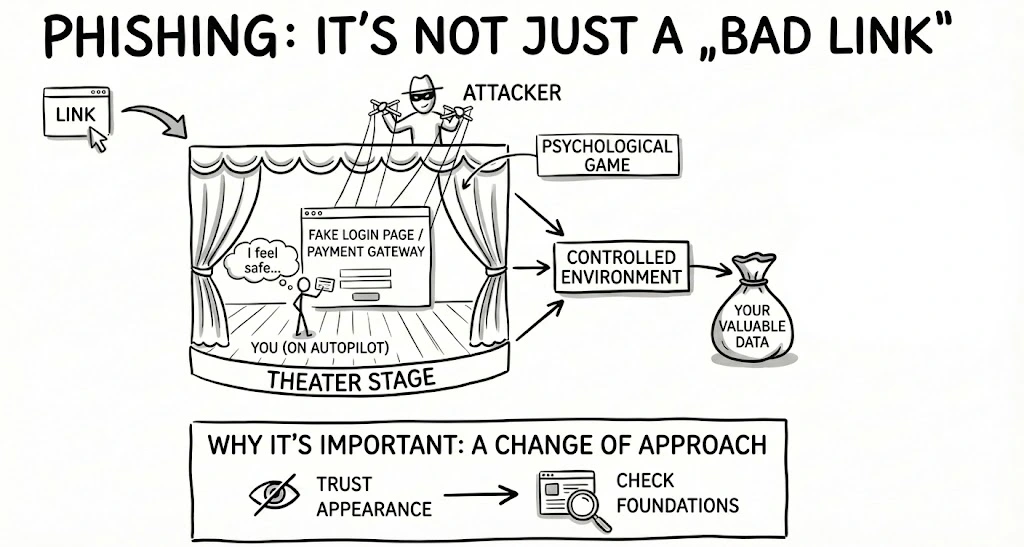
The illusion of a "controlled environment"
We often think of phishing in terms of a “bad link.” However, it is a far more sophisticated process. An attacker doesn’t just want you to click; they want you to feel at home. They create a stage for you – a fake login page, a payment gateway, or a contest panel – where every move you make is recorded.
This is not a technical glitch; it is a psychological game. The scammer counts on you acting on “autopilot,” hurriedly entering data where you feel secure.
Why it matters: Understanding that you are being lured into a “theater” changes your approach. You stop trusting the appearance of the site and start checking its foundations.
“That is exactly where the attack lies. It is an attempt to obtain data from us. The cybercriminal wants me to land in his controlled environment (…) and leave my valuable data there.” (Łukasz Zajdel)
The green padlock myth: encryption is not a safety guarantee
This is one of the most harmful myths on today’s internet. For years, we were taught: “padlock in the address bar = the site is safe.” This is false.
The padlock (SSL/TLS certificate) means only one thing: the connection between you and the server is encrypted. No one from the outside can eavesdrop on your “conversation.” But if there is a scammer on the other end, you simply have a secure, encrypted connection with a scammer. Modern phishing sites use free security certificates en masse to lower your guard.
Why it matters: The presence of a padlock is necessary but insufficient. You must click on the padlock and inspect the certificate to see who it was issued to – whether it truly belongs to your bank or an anonymous entity.
The devil is in the URLs and typos
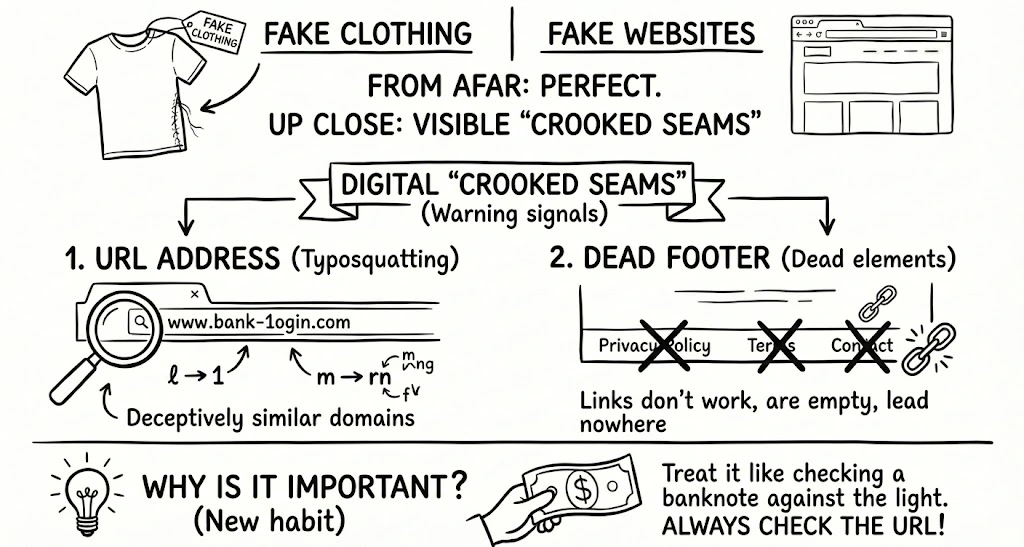
Fake websites are like counterfeit designer clothes – from a distance, they look perfect, but up close, you can see the crooked seams. In the digital world, those “seams” are the URLs and dead interface elements.
“The browser bar is a place where everything blurs; for example, there might be a dot somewhere that already changes a lot.” (Łukasz Zajdel)
Cybercriminals use typosquatting—registering domains strikingly similar to the real ones, such as replacing the letter “l” with the number “1” or “m” with “rn.” A second warning sign is a “dead footer.” On fake sites, links to the “Privacy Policy,” “Terms and Conditions,” or “Contact” often don’t work, are empty, or lead nowhere, because the scammer didn’t bother to copy them.
Why it matters: Checking the URL is a habit that must become second nature. Treat it like checking a banknote against the light.
Where to report a fake website?
You don’t have to fight alone. You have powerful tools at your disposal. Antivirus programs with “Safe Banking” features open websites in an isolated environment (a so-called “sandbox”), blocking tracking scripts.
If you have doubts, slow down. Check your data on the government website to see if it has been leaked before.
It’s not about living in fear, but about “digital hygiene”. Using the right tools takes the burden of constant alarm off your shoulders.
“Let’s not fall into paranoia either… we have to function, but it’s worth being aware that you have to be careful on the Internet.” (Łukasz Zajdel)
Reflection for the future
Recognizing fake websites is a skill that will become harder every year. In the age of AI, which can write flawless text in any language, “broken English” (or Polish) will no longer be a tell-tale sign of a scam.
Therefore, the most important antivirus remains your intuition and the principle of limited trust. If a site requires a strange, unusual action from you (e.g., an additional login or providing a PESEL number to claim a free prize) – stop. In the digital world, haste is always a poor counselor.
You can listen to the full interview on Radio Zachód by clicking here
Looking to enhance your cybersecurity?
Contact us!
Leave your details – we’ll call you back
Our specialist will get back to you no later than the next business day. You don’t have to fill in the message field, but a brief note about the topic you’re interested in will be a valuable hint for us.